Britain's Licensed Slot Venues: Tracing How Layered Eligibility Filters Guide Access to Initial Reward Tiers
Ines Wagner · Oct 6, 2026

Britain's Licensed Slot Venues: Tracing How Layered Eligibility Filters Guide Access to Initial Reward Tiers
Britain's licensed slot venues operate under structured systems where eligibility filters determine who gains entry to reward tiers, and these layers build sequentially from basic registration through verification steps and activity thresholds. Operators apply these filters to maintain compliance while guiding players toward initial rewards such as deposit matches or free credits that appear only after certain conditions clear. Data from regulatory reports indicates that venues process thousands of applications daily, with filters checking residency, age confirmation, and account details before any reward activation occurs.
Initial filters focus on identity and location, requiring users to submit government-issued identification and proof of address that matches the registered postcode. Once these pass, venues unlock the first reward tier, often tied to a minimum deposit that confirms the account as active. Observers note that this sequence prevents premature access while allowing operators to track patterns across their platforms, and many sites integrate automated checks that complete within minutes during standard business hours.
Core Components of Layered Filters
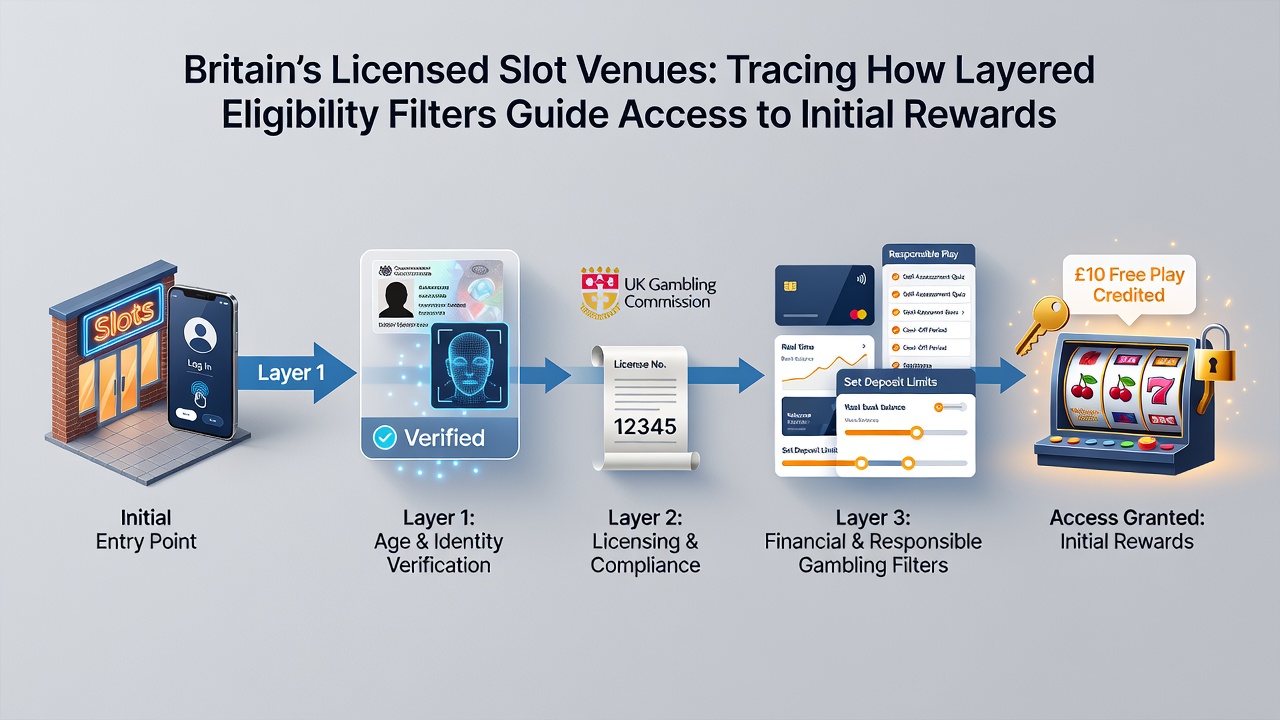
Eligibility layers typically divide into three main stages that progress from passive verification to active participation requirements. The first stage handles personal details and security questions, the second adds financial confirmation through payment method validation, and the third monitors initial play or deposit volume before releasing higher-value rewards. Research from the Canadian Centre on Substance Use and Addiction highlights similar multi-stage approaches in comparable jurisdictions, where each layer reduces risk exposure for both venues and users.
Venues in Britain enforce these stages uniformly across digital and physical locations, though digital platforms handle the majority of reward distributions because they can apply real-time database cross-checks. Players who complete the first two layers often receive notifications about available tiers, while those who stall at verification receive prompts to upload missing documents. This process creates a clear pathway that aligns with broader industry standards for responsible access management.
Verification Timelines and Reward Unlocking
Most venues complete basic identity checks within 24 hours, after which the system activates the entry-level reward tier automatically. Additional layers activate based on cumulative spend or session counts, and operators record these metrics through centralized systems that update in real time. Figures from industry analyses show that completion rates for the first tier hover around 70 percent for accounts that reach the deposit stage, while subsequent tiers see lower progression as filters tighten around play history and account age.
As of October 2026, several major operators have adjusted their filter sequences to incorporate enhanced address validation through third-party services, a change that extends average processing by a few hours but improves accuracy for cross-border accounts. Those who study these systems report that the adjustments align with updates in international data-sharing agreements, allowing venues to reference records from sources such as the Australian Institute of Family Studies for comparative insights on verification effectiveness.
Impact on Player Progression Through Tiers
Once past initial filters, players encounter reward structures that scale with continued engagement, and each new tier requires meeting updated thresholds such as total deposits or completed sessions within a set window. This design encourages sustained activity while maintaining clear boundaries that reset periodically. Case examples from licensed operations demonstrate that players who advance through two or more layers tend to maintain accounts longer, though exact retention statistics vary by venue size and marketing focus.
Filters also account for payment source consistency, where repeated use of the same card or e-wallet strengthens eligibility for elevated tiers. Disruptions occur when new payment methods appear or when activity drops below minimums, prompting the system to hold rewards until conditions stabilize. Experts have observed that these mechanisms create predictable pathways that both operators and users can follow without ambiguity.
Conclusion
Layered eligibility filters in Britain's licensed slot venues establish a methodical route from registration to initial reward access, relying on sequential checks that balance security with user progression. These systems continue to evolve with technological improvements and cross-jurisdictional data practices, shaping how rewards become available in both digital and land-based settings. The structure ensures that only accounts meeting all specified criteria unlock each tier, maintaining operational consistency across the regulated landscape.